



Key Points of Auto lamp Injection Mold Design
Automobile, as the main means of transportation for human, are becoming more and more popular. Meanwhile, the appearance of cars is becoming more and more diversified and the shape of headlamps is getting closer and closer to the shape of sports cars, which is very sporty. This brings new demands to the mold design. The appearance requirements of automotive lamps are high; several important parts are transparent parts, electroplated parts, etc.
It can be said that the parts with the highest appearance requirements of the automobile are the auto lamps, so the mold design and manufacture requirements are extremely high.
This article mainly focuses on some design points of the Auto lamp injection mold:
Lens molds are generally left and right lens common mode. Moulds are large and the parting surface is complicated. Therefore, the molded part and the Plate adopt an integrated structure, that is, the fixed mould A Plate of the mold is a fixed molded part,and the movable mould B Plate is a movable molded part. The advantage of this structure is that the structure is compact, the strength and rigidity are good and the mold volume is small, which can reduce some cumbersome processes such as opening the frame, arranging the frame and manufacturing the wedge.
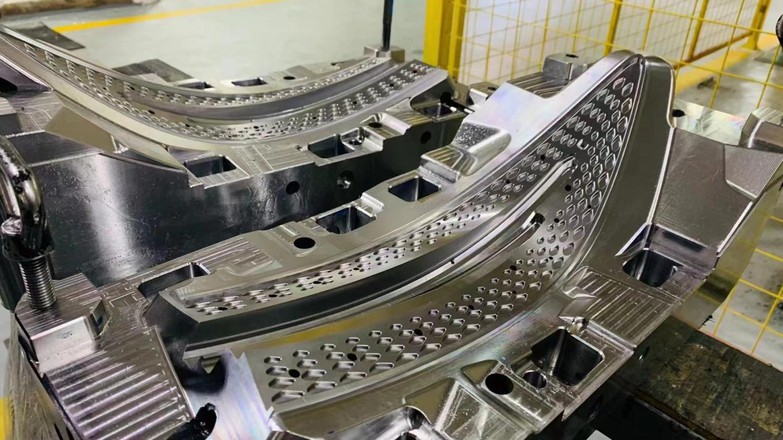

1. The parting surface is smooth and flat, with no wrinkle on the constructed surface and no small facet appears (easy to knives during CNC machining, reducing the machining accuracy). Build the parting surface with the extended surface, mesh
surface and the sweep surface as far as possible, or extend 10-20mm sealing surface first, then make stretching surface, transition surface and the size design of sealing surface mold. High-speed machining is required when finish machining for the Auto lamp Injection mold surface and the parting surface; the speed of the machine tool spindle is guaranteed to be at least 15,000 rpm.
2. Clearance design: The width of mold parting surface is 30MM, and apart from the area of parting surface, fixed mould and movable mould should keep space 1mm. and no finish machining is needed during processing, which can reduce the
processing time. Keep-space is not only for peripheral parting surface, but also the large-area parting surface. Special note: The exhaust slot is included in the width of the mold parting surface. The supporting block should be designed in a large keep-space area to ensure the uniform force of the mold and avoid the flashing when long-term production of the mold. The protruding position is designed to be chamfered, the recess is designed to be rounded, and the larger chamfers and rounded corners are designed as much as possible. While designing the keep-space of the kiss-off hole's area, the vent hole should be designed in the fixed mould or the movable mould to facilitate the discharge of the compressed air when the mold is closed.

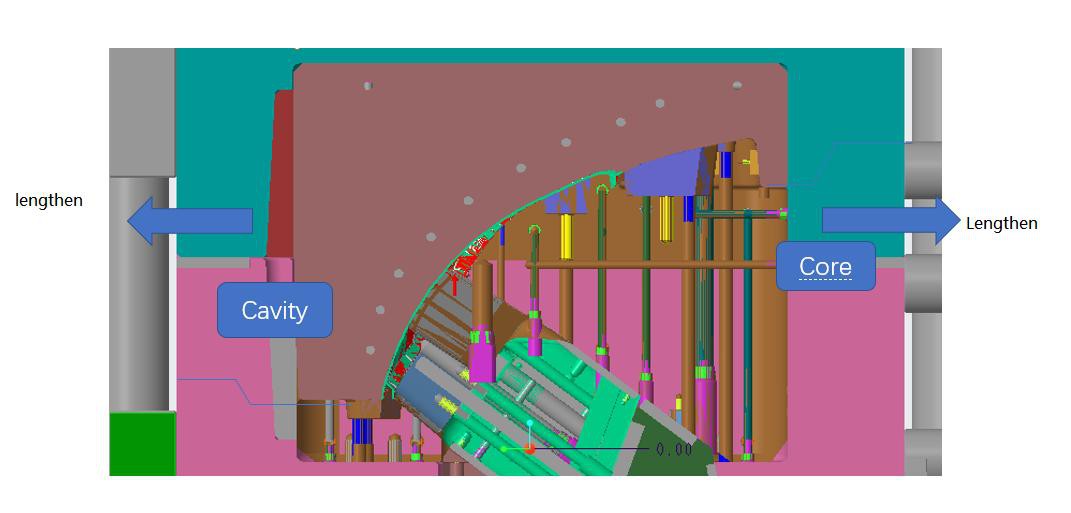
3. At present, the angle between the parting surface of the general lens and the mounting surface of the mold is very large. Many types of automobile headlamps have reached or exceeded 45º, which will cause a large lateral force when the mold
is injected in the lens length direction and prone to happen side slip and the unilateral opening of the mold, thus the product produced is unevenly fused, the parallel light passing through the lens is refracted, and the assembled headlamp may
not meet the detection requirements of the vehicle light line. The solution is to evenly lengthen the mold on both sides of the lens length direction, and at the same time, the fixed mould and movable mould interlocks, and the wear block is added at the position of the stop.
4. The fixed mould and movable mould of the lens molds are all high-gloss surfaces. During the injection molding, vacuum areas are generated on both sides of the fixed mould and movable mould. The movable mould sides generally have a retracting slider, and the air enters when the mold is opened, which will make the injection parts unbalanced in force and side-turning and scrape the parts. Therefore, it is necessary to make an undercut of no more than 1 mm when necessary in the inner side of the lens circumference.
The above just introduces some points of the design about the Auto lamp injection mold. It should be pointed out that many beginners think that the lamp molds are bilaterally symmetrical - this is a serious misunderstanding. For example, the
light-emitting surface of the reflector is left and right symmetrical; it's just a symmetrical shape. In addition, the installation position of all lamp installation is consistent with each other - It must not be a mirror image relationship.
Would you like a cost estimate for a specific lamp mold,feel free to contact Euromicron mould.
Hot Tags: injection mold for auto lamp, China injection mold for auto lamp manufacturers, suppliers, factory, High Precision Mold for Automobile Bumper, Injection Mold for Auto Lamp, Injection Mold for Car Door Panel, Injection Mold for Car Interior Trim, Plastic Injection Mold